

Stranger Things Finale - A Review (Part I)
Did Eleven Really Die? A Bittersweet End to a Nostalgic Journey.

(Includes Spoilers)

…the writers are offering us a Schrodinger’s Cat kind of solution: She is both dead AND alive. But you know what? We’ll take it. They are right to linger between two choices. Killing her off makes sense narratively. Not killing her makes all of us (themselves included, one suspects) feel better. So maybe Kali did create an illusion with her mind before she died herself. Maybe Eleven did escape and is now somewhere in South America in search of those three waterfalls.
Stranger Things, the Netflix series created by the twin brothers Matt and Ross Duffer, is an utterly enthralling 1980s-set supernatural sci-fi thriller that came out of nowhere and instantly became an unexpected hit of gigantic proportions, one of the few unifying cultural phenomena of the last decade. It’s all about a group of four adorable, nerdy boys: Mike (Finn Wolfhard), Dustin (Gaten Matarazzo), Lucas Caleb McLaughlin) and Will (Noah Schnapp) who live in the little town of Hawkins, Indiana, which, much like the hellmouth of Sunnyvale in Buffy The Vampire Slayer, is the matrix of all things spooky and dark. As Will goes missing, the rest of them must discover what happened to him and, in the process, save their town and the world at large from otherworldly monsters and interdimensional catastrophes, with the help of Eleven (Millie Bobby Brown), a strange girl with supernatural powers. A group of older teenagers are added as the story progresses: Nancy (Natalia Dyer), Jonathan (Charlie Heaton), Steve (Joe Keery), Robin (Maya Hawke), Eddie (Joseph Quinn), and the younger ones Max (Sadie Sink) and Erica (Priah Ferguson), who become part of the core group. And of course Joyce (Winona Ryder, whose career the show reserected) and Jim Hopper (David Harbour), while some familiar faces from 80s and 90s culture are added periodically - usually in smaller roles: Sean Astin (Bob Newby), Paul Reiser (Dr. Sam Owens), Cary Elwes (Mayor Larry Kline), Matthew Modine (Dr. Martin Brenner) and in this last season, Linda Hamilton (Dr. Kay)
The pilot of Stranger Things premiered in 2016, just three days before Donald Trump was officially announced as the presidential nominee of the US Republican Party, a fact that was considered as significant by many who saw connections between his presidency and the nefarious activities taking place in the show’s underground government labs, which were aided by the military and threatened to bring about a worldwide catastrophe of apocalyptic proportions, while only a handful of people were aware of the fact…
The fifth and final season was released in three volumes during the Holidays of 2025, culminating in the finale, which was aired on New Year’s Day 2026, as a 128-minute-long movie on Netflix (which was also available in more than 620 theatres across the US). As the actors have aged beyond their roles (they are now twenty-somethings and thirty-somethings pretending to be 16, 18 or 20), the message that they are now adults (or at least on their way of becoming ones) is punctuated with clarity. Besides, battling monsters can age you…
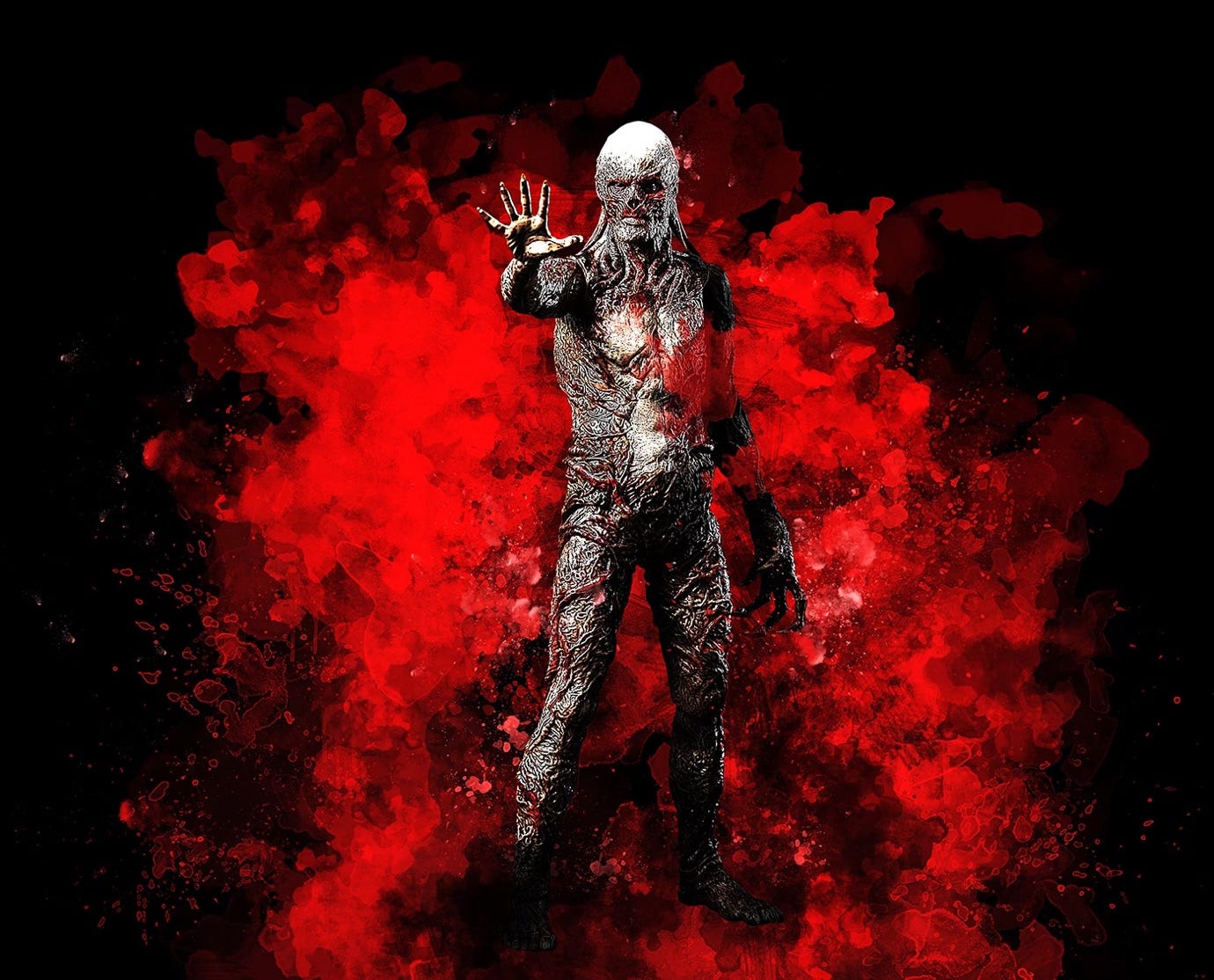
It begins with Hawkings being again under threat by supernatural horrors and under a military quarantine, as the rifts have been opened. Our interpit gang is trying to find and kill Vecna (Jamie Campbell Bower), the big baddy of the piece, who has disappeared, while Eleven is being hunted by the army, forcing her to go into hiding. A new - the ultimate as it happens – more scary foe appears in the sky, kids get kidnapped by Vecna to aid the coming of the impending apocalypse, Will gets Eleven-like powers and gets into Vecna’s mind to lure him out of his hiding, Max who is still in a coma, resides inside Vecna’s memories, while Eleven and her lab sister / Eight, make a suicide pack to end the plans of the military to create more of them, and end the cycle of pain and Vecna once and for all. We also get to see Henry’s formative trauma, his beginnings as Vecna, and his connection with a newly discovered world-ending threat.
When it comes to the fantasy genre, sticking the landing is always a big ask, but we can’t help but expect it (I still haven’t recovered from that infuriating Battlestar Galactica ending, btw!) There’s so much borrowing from its own convoluted mythology here, there are so many familiar, repetitive and unnecessary at this late hour twists, and random (and as it turns out open-ended) subplots that were obviously created in order to be pigeonholed into the (unsatisfying) conclusion to add spectacle to the ending that it all stopped making sense.
It’s a common enough problem for the fantasy genre: A core idea that works, that it is even quite spectacular, becomes a massive (unexpected in this case) success, and then the creators need to keep piling on details and subplots and protracted explanations on and on to keep this thing going. Each season expands its lore and scope until the web is so convoluted that none of it makes sense anymore, and there’s no real solution that can satisfy. By that time, of course, you are so invested in it that it doesn’t matter. Then the self-referential callbacks begin, and the fan service. Not that it doesn’t work… Once you love the characters. And we do. But God, there is so much unnecessary drivel being added in the finale that it is almost insulting. That whole thing with the kidnapped kids? What was it other than a way to fill time before we get to the final episode? Not that we didn’t enjoy the Alice in Wonderland quality at times, but what was it other than a lot of running in the desert, trying to leave or reach that cave? How much of that were we supposed to endure before getting to the point? The build-up lasted so long, we were bound to expect some form of mind-blowing conclusion, a spectacular farewell that was promised by the vastness of the lore, but was sadly never really offered. Instead, we were given a safe, CGI extravaganza and more questions, more puzzles that remain (and will remain, given that this is the finale) unsolved and unresolved. In short, the ill-timed widening of the mythology of the show on a new scale just sacrifices the importance of the conclusion.
In earlier seasons we were more easily seduced by our love of the characters into buying the mythos, that yes, they did all the wondrous things they set out to do, armed with walkie-talkies, a slingshot, a high school level grasp on science, a shared knowledge of the Dungeons & Dragons world and their friendship, but here we are asked to suspend our disbelief to an even more ridiculous degree: in the two years that elapsed between the last time we saw them and now, they have all miraculously turned into super soldiers / gorilla fighters apparently, each capable of taking on the United States military singlehandedly, and being nifty with all kinds of triangulating systems, and remote controls that open all doors, and military weaponry, including hand grenades (where did they get those? And how could they smuggle them in the heavily secured periphery of the town? When did they go from being armed with Home Alone-like, improvised weapons from a hardware store and their wits, into becoming full throttled Ramboesque uber soldiers? Wasn’t the point of the story that these are ordinary (bookish, geeky, sure!) teenagers who found themselves in extraordinary circumstances? Also, what was the point of using codes to communicate via public radio - through Robin, who is now a DJ and apparently in charge of the Radio Station, despite that she is still in high school - when they would talk openly about what the codes meant to each other via the walkie-talkies, which surely, the military can intercept?
And why the hell can Eleven jump/fly like Superman now? When did that happen? Why didn’t she before? Are we supposed to just believe that it was because she practised really hard, while wearing that ridiculous exercise outfit? (What was that about, by the way? A Bionic Woman reference? Or did she pissed off the costume designers of the show who got creative with their revenge? Because that other diving/bathing suit was also an abomination… And what’s with the lip filler? Why would a beautiful, young actress do that to herself I ask you?! Nevermind that she is supposed to be a teenager in the 80s…) And why give Will Eleven-like powers, too, all of a sudden, and have him killing demogorgons by staring? I guess it was so we would not be forced to see him rub his neck in horror every time he was in-synch with Vecna (in the manner of Harry Potter getting headaches or Frodo being affected by the Ring, etc., etc.) But why make him the same as Eleven? Just to enter that one time (or two, who cares anymore), Vecna’s mind? What is the use of that out of the blue? Just to have him translate what Vecna is feeling about the cave and his first kill, I guess. Ok, but doesn’t it defeat the point that Eleven was unique in this story (and all her lab brothers and sisters for that matter)? And what was the point of going to Henry’s high school memories? What was it if not another dead end? And how was Max able to furnish the cave with chairs and tables and pillows and things? If it’s Vecna’s memory-scape, surely it was empty and only inhabited by the guy with the suitcase. Also, how come she never saw him in the two years she was there, while Holly and the kids did? And, also, an equally crucial question: why the hell is Dustin wearing a fur cape now?
Henry’s descent into evil was because he was manipulated by the red stone (and the abyss/planet/pulsating heart in the sky, etc), we are told (that apparently had vocal cords, and spoke English as it whispered to him creepily “Find me”). Fair enough. He was “just a kid”, as Will says, but this too is negated as he already attempted to kill the man in the cave BEFORE he got to open his suitcase and be seduced into the dark side. In short, he was an evil child to begin with. Or was he already a goner the minute he entered the cave, just because he was in the proximity of the stone/abyss (like the horcruxes in Harry Potter?) and killing that guy was an indication that he was already under the influence of the abyss? That’s yet another thing that remains unclear and open-ended…. Speaking of the dreaded “Abyss”, as it turns out, it was nothing but another SGI wasteland that looks pretty similar to the upside down… (It’s interesting how the show’s endlessly expandable CGI world made it somehow smaller)
As the show became more and more successul it got “grander”, more ambitious, stacking plot over plot in an effort to sustain the momentum and prolong the impending ending, and it happens here too: new characters are introduced even in these late hour. (All those kids! Why?) Instead of bringing things together, we are led outwards into more and more expanding puzzles and story threads. And who was that guy in the cave Herny killed? And what the hell was in that suitcase? A piece of that - whatever it was - above them, picking from the hole Nancy made with her gun (because apparently you can shoot planets and activate them. Sure.) Though admittedly, the bit about Hopper accidentally shooting the water tank and hurting Eleven, and then turning out to have been a Vecna mind trick to bring her back, was an impressive bit of writing! (Kudos for that one! It felt like it used to, at that moment!) Actually there were quite a few beautiful moments in the finale that brought to mind others from previous seasons (Read more about these here: “The Emotional Legacy of Stranger Things: A Farewell”)
Additionally, how come they went from talking like normal teenagers who are genuinely fond of each other, into being snarky all the time, and demeaning to each other in those first four episodes? Why the constant sarcasm in this season? Snarky remarks work when not ALL the characters are shooting them at each other randomly and on all occasions. It’s the West Wing problem (No, I don’t mean the pomposity and the American nationalism spiel, I mean the dialogues): not every single person is equally witty/condescending, surely?! They can’t ALL possess the same degree of snarkiness, smug dark humour and desire to eliminate each other with one-liners! When everyone is doing it, and at all times, it’s no longer funny; it’s exasperating! This is what the character of Murrey (Brett Gelman) - who is annoying even in the best of times - is there for after all: to spew sarcastic remarks at everybody, (and also WHY is he there? How come he is now part of the core group? I get it we needed someone to translate from Russian to English in the fourth season but what is he doing here now?)
All the new storylines seem to side track into derivitive territory, exposition, repetition: the endless “crawls” (that seem to be there in order to give Hopper something to do in this season), the demogorgons that we’ve seen again and again, and frankly had enough of, Eleven and Hopper fighting, another interdimensional horror that arrives out of nowhere (and is never satisfactoraly explained from where, how or why) our heroes facing a new arachnid-like monster by the end, Vecna again (and again, and again), creepily walking in the distance behind whoever he is chasing, his hand uncoiling into vines as he approaches his pray, etc, etc.
And how annoying, how, permit me to say it, lazy to turn Nancy (a tiny, worryingly thin young woman by the way) into some sort of female Rambo, armed to the gills and shooting at anything that moves? But this is what white, heterosexual male writers do when they want to erase the entire history of their gender/race/kind, (AND safeguard themselves against any kind of backlash possibility): they turn to symbolic gestures (And they all have the same notion about what these should be) So Nancy becomes a warrior queen (because women can be badasses too, didn’t you know that?). On the same note, Will gets a protracted and at this point unnessary coming out speech (because: look at us, we love the gays!), and Robin is the lesbian who is corky, loving, funny, wise, understanding, friendly, clever, brave, witty, hard working, empathetic, a music lover, stylish, and all kinds of cool. Similalry, Erica, (the only black girl in the group) is a sassy, kind of an angry brat who only speaks with snarky one-liners (Because all black women are fearless. And fierce, let us not forget) Ah, yes, and she also happens to love math (because black people can do math too, did you know that?!) I’m actually shocked that no trans “woman” (aka man in a dress) was shoehorned in the story to complete the “Look-at-us-are-woke” set… Can I suggest something to all of you white writer guys (AND the female ones who write like you do, in order to be employed)? What if you wrote people who are not like you, as if they were still actual human beings? What if the fact that they are not white, heterosexual and male is not their defining characteristic and it does not affect their humanity, turning them into the opposite of older formulaic stereotypes and so into new formulaic stereotypes which we’ve seen a thousand times in the last few years? And which - let us be frank - are created in order to protect your own demographic from criticism by proving your virtue? Just a thought. All the above are especially annoying choices when you think that these are gifted writers! In short, we expect more from you, Duffer twins: Look at how great you are when writing boys talking with other boys, for example! (You nailed that, by the way!)
Sustaining momentum for four seasons while offering very little in terms of actual, let alone satisfying solutions to the multi-layered puzzle, is no small feat. (Were we supposed to be satisfied with “Henry opened the Upside Down”. Or “Eleven did”? Is that it?) But here, at the end of things, we do want explanations and satisfying solutions. Coming up with new threats and dangers and dangling them in front of us to prolong the moment these solutions will be offered to us, is no longer OK. We went round and round the same rote so many times already: it was the demogorgons, it was the government and the science guys. the whole upside down. Then the scary bat things that killed Eddie (and never appear again by the way), then it was the army. It was Eleven. It was Herny all along. It was Vecna. It’s another world like ours, but upside down (Cool, explain the logistics). No it’s a different dimension (aha. Tell me more). It’s the upside down, it’s the right side up, it’s the red thing in the sky, it’s the thing in the suitcase… It’s a planet, it’s a wormhole, it’s a heart, it’s another giant arachnid, it’s the abyss, it’s a different world, it’s another dimension, it’s worlds colliding? What? Why? HOW? (Specifically!)
We don’t expect a scientifically solid solution (though one is actually attempted, in the most ridiculous scene of the whole season, when Dustin seems to possess a Physics professor’s kind of knowledge and basically suggests they need to kill Vecna – which was the plan last season too), we just want to hear a convincingly structured mythological solution. Because we are with you, Duffer boys. We are willing to believe it, like we believed the talking Christmas lights, that a girl can kill from a distance just because she moves her hand and stares. That if blood runs from her nose, it means her magic works. That four boys from Indiana can save the world using their Dungeons and Dragons skills. That walkie-talkies work across distances that defy logic, let alone in different dimensions. That a song can save you from supernatural monsters, (or inddeed that an American small-town teenage girl who came from a troubled background has ever heard of Kate Bush) That going through the upside down from a hole in the ceiling is a good plan, that monsters with flower heads share one mind, etc etc etc. We bought it all. That is why we kept coming. And because we thought you – unlike us - knew how it would all end. We trusted that you had a plan that made sense. We thought we were gearing up for the big, satisfactory reveal that would tie all the ends together, but we were offered new ones basically. AND you killed Eleven to distract us! (Ts! Ts!) For four seasons, we bought it all. All of it. Because, as long as there’s an underlying “logic” in your mythology, we are with you, but you’ve abandoned ship. In this final installment, you keep looking for solutions in aesthecs – which is to say, in CGI (or FX or whatever it is called now): in the melting rooms, the giant living fleshy wall around Hawkins, the pulsating red thing in the sky, the desert like plains of Henry’s memory-scape, and more veiny vines everywhere, and more kids with the vine thing in their mouth, and another arachnid-like monster at the end (which we’ve seen before, but it doesn’t count because this one is bigger?) and so on. Which is to say in the creation of more built-up, more labyrinthian road trips that, as it happens, lead nowhere.
It is not the first time that the expansion of the mythos doesn’t work, but it’s the first time that it got really annoying. Given that this is it. We won’t get to know the answer in the next season, as there isn’t one. Which prompts the question. Is there going to be another season, perhaps, and you are keeping it from us? A spin-off? A movie? A book? A cartoon? A comic book? Something? Is that why most of the long-awaited answers are not there? Is that why you’ve added new questions? Are we being mad at you for no reason? Because this is just not satisfying as an ending. Not even if you add the emotional farewells that were used to tug at our heartstrings and distract us from the mess.
Actually, we don’t fault the writers (well, we kind of do, but nevermind…) because, despite the disappointing finale, they can still be credited with creating one of the most memorable shows out there. And because none of it is easy. This business of creating things. We are angry. But we get it. (Forgive us, we are just letting steam off…) The fact that we are THAT aggrieved, that exasperated at the finale, at the creators, is a testament to how much we care about the show, how great it was initially.)
They could have left it at the Vecna plot, him being One / Henry, the house that retains his memories and evil energy, the ticking clock and all that. There was still some semblance of logic behind the world-building up until then. There was even an elegance in that explanation despite the plot holes, (we can forgive those, as long as there is a unifying theory in the end), but they kept going on and on.We went from the sinister government experiments and the villainous Papa and company, to the upside down, the Cold War Russians, the Mind Flayer, the mind hive, then to Henry /Vecna, back to the evil military, the experiments, and now the thing in the sky, the new military sublot, the physics lesson, the pregnant girls (how disturbing was that?!), Eight, the blood transfucions, the melting goop/ liquid walls that suddenly and conviently stopped melting (what the hell was that about?) that Sinister Dr Kay (a criminally under-used Linda Hamilton), who is so one-dimensional she is basically a cartoon, (and so is the soldier with the scar, btw). Then the mysterious man in the cave, diving deeper into Henry’s origin story, climping up that tower, (which was nothing but another obstacle to be overcome, another moment of pointless drama), and the colliding other-dimensional planet. (Planet? Really?? Is that it? Is this what it was all about from the beginning?)
This is not uncommon when it comes to sci-fi. Think of Marge Piercy, Philip K. Dick, etc. So often, the world-building takes precedence over the “logic” of the narrative or the need for a neat ending. It’s a decree of the fantasy genre that as long as the writing is there, the ending is irrelevant, unnecessary even. But is it ever? Given the audaciousness, the boldness, the richness of the created universe, how can we avoid being disappointed when it is not offered? There is no real closure here, only more expansion of the lore. Which is why Eleven HAD to die. Her death, her sacrifice serving as an avatar of closure, where there’s hardly any. Because none of it makes sense, despite the endless explanations. And there are a lot of them.
But the thing that mattered in this season, which marked the finale, is, of course, Eleven’s death. It’s funny how a middle-aged mum, an overweight sheriff and a bunch of teenagers are terrorising and outwitting the American military and fighting monsters, and none of them is ever getting as much as a scratch on them (well, very few at least). Even with Eleven doing the heavy lifting, it’s not believable. And yet it is she who dies in the end. The super heroine. The extraordinary supernatural lab child. It is indeed amazing that there are hardly any casualties, given the endless parade of life-threatening happenings and monsters. These kids are immune to danger, no matter what. They don’t even cough when they are enveloped by those creepy flying particles in the Upside Down! Not one single allergic among them apparently! So far, each “crawl”, each dive into otherworldly dimensions, memory realms and mind worlds, each battle with the badies (the scientists, the army, the monsters, etc.) ends - predictably by now - in near misses, in the nick-of-time escapes. Just like in cartoons. Which makes the symbolism of Eleven’s death unearned. It’s as if she dies because a show must kill off at least one of its leads these days to indicate that heroes and heroines do. Need to. To add gravitas to a weightless, safe and lacking ending. So she evaporates into thin air. Sacrificing herself for the larger good of her friends and the world at large. And it is devastating! Later, Will’s hypothetical scenario about her survival makes her death more palatable. But only barely: we can’t help but wish that his wishful thinking is true, even though it would undo the significance of her sacrifice.
“We are not trying to shock or upset anyone”, the Duffer Brothers have said in an interview when asked about killing off any characters. And yet they did kill off the central figure of the show. In the finale, by adding Will’s theory that Eleven might have survived, they are, however, attempting to take it back, by offering us a Schrodinger’s Cat kind of solution: She is both dead AND alive. But you know what? We’ll take it. They are right to linger between two choices. Killing her off makes sense narratively. Not killing her makes all of us (themselves included, one suspects) feel better. So maybe Kali did create an illusion with her mind before she died herself. Maybe Eleven did escape and is now somewhere in South America in search of those three waterfalls. (Though one hopes for her sake, not in Venezuela… Because the American army may be just around the corner …)
But then again, maybe this was nothing but a mindscape (If so, whose? Henry’s? Eleven’s? Will’s?) I return to Buffy and to that episode where we see an alternative reality to the myth that suggests she is not a fearless Vampire Slayer but a mental patient. A sick, catatonic girl trapped inside her mind, imagining that she is battling Vampires, monsters and supernatural forces, while she is locked up in a mental institution. Locked inside her own mind. This implies that the whole thing, the whole show, was nothing but her own consciousness, her own dreamscape, and what she was fighting was nothing but her mind creations, her own illness. We’ve seen it elsewhere, of course: Matrix (1999), Fight Club (1999), Identity (2003), not to mention in several philosophies and traditions: the world is nothing but an illusion, Buddhists tell us, (or a simulation, if you are prone to seeing things in terms of codes.) What if this is what the writers of Stranger Thinsg intended all along? (Which might explain the video Game aesthetics…)
If so, and if this is Eleven’s “dream”, then her death is nothing but a liberation from a form of mental captivity, and it might indicate that she is finally free!
Art & Words Copyright © Fanitsa Petrou.
The illustrations are available as T-shirts, stickers, mugs, phone cases, etc. (Click on images)
Thank you for reading. If you enjoy my essays and believe they have value, please consider becoming a free subscriber, share and hit the like button.
I offer my work for free (even though it is neither free nor effortless to create it), but if you can afford it, please consider becoming a paid subscriber, so that I can continue this effort.
The cost of a monthly subscription is less than the cost of one latte coffee or a frappe, but if you don’t want to go for a paid subscription here, please consider sending your preferred amount through PayPal
Thank you!